Ultra-Processed Foods and Food Sensitivity: What the MRT Panel Reveals About UPFs
 Kerry Watson, NTP, RWP
Nutritional Therapy Practitioner & Registered Wellness Professional • Evidence-based food sensitivity guidance
Ultra-processed foods now make up nearly 60% of the average American diet. At the exact same time, rates of chronic inflammation, autoimmune conditions, IBS, and food-related symptoms are through the roof. This is not a coincidence, and the connection runs much deeper than just saying junk food is bad for you.
The real issue isn’t calories or sugar. Ultra-processed foods are just delivery vehicles for chemical additives. We test many of these chemicals on the MRT 176 panel because they trigger delayed immune responses in sensitive people.
In This Guide
What Are Ultra-Processed Foods?
Ultra-processed foods are industrial formulations made from food derivatives and additives, with hardly any intact food left. Food companies design them for convenience, long shelf life, and addictive flavors, not for nutrition.
Researchers at the University of São Paulo created the NOVA food classification system. NOVA doesn’t classify foods by protein, fat, or carbs. It classifies them by their degree of industrial processing.
The NOVA Classification
Group 1: Unprocessed / Minimally Processed
Fresh fruit, vegetables, eggs, meat, fish, milk, grains, legumes, nuts, herbs. Nothing added, nothing removed.
Group 2: Processed Culinary Ingredients
Oils, butter, sugar, salt, and flour. These are substances extracted from Group 1 foods that you use in home cooking.
Group 3: Processed Foods
Canned vegetables, artisan cheese, cured meats, fresh bread. These are Group 1 foods modified by Group 2 ingredients. They have simple, recognizable ingredient lists.
Group 4: Ultra-Processed Foods
Industrial formulations with 5 or more ingredients. These typically include substances you do not use in home cooking, like high-fructose corn syrup, hydrogenated oils, modified starches, emulsifiers, flavor enhancers, colorants, and preservatives.
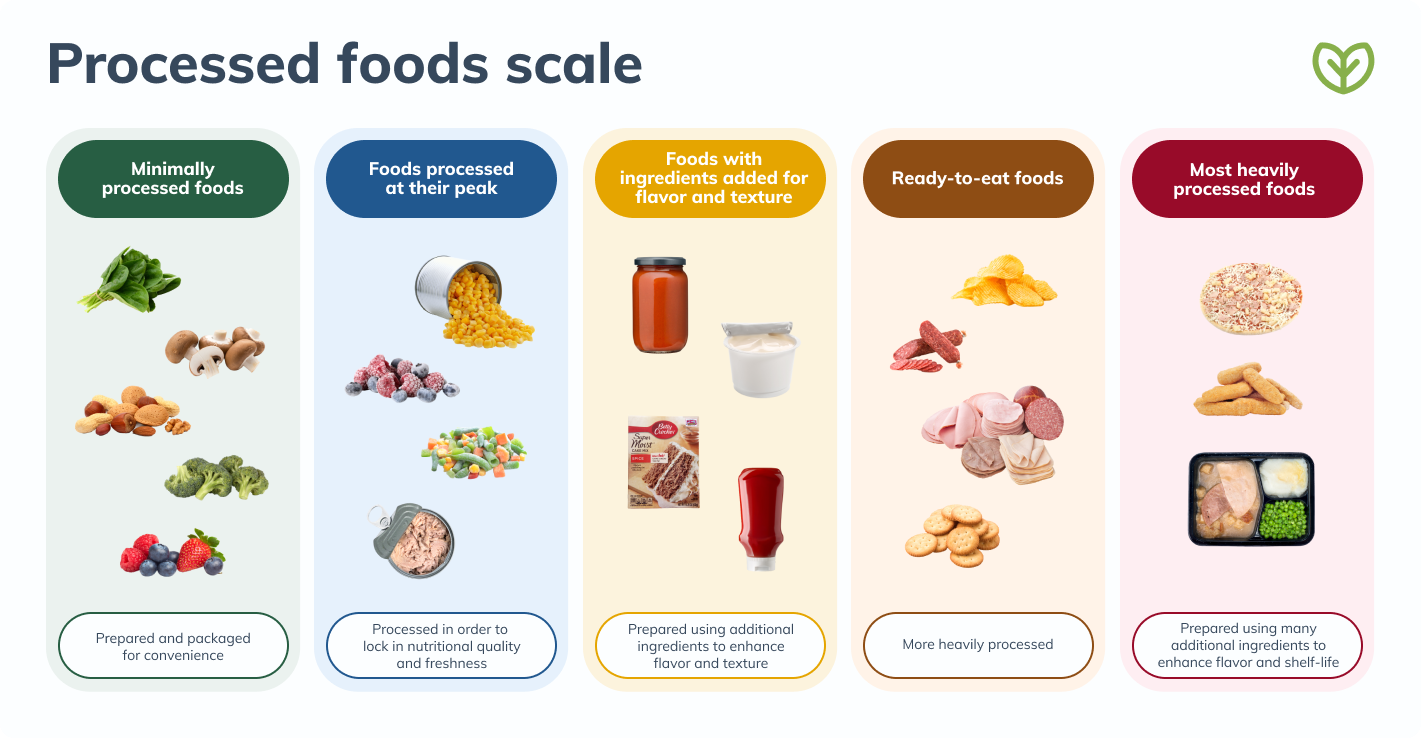
Visual reference used in clinical practice by Kerry Watson, NTP, RWP
The defining feature of Group 4 isn’t about empty calories. It is that the product contains industrial additives you would never keep in your home kitchen. Things like soy lecithin, citric acid, xanthan gum, “natural flavors,” carrageenan, and sodium benzoate are the real hallmarks of ultra-processing.
This is where the MRT connection becomes so important: we specifically test for many of these industrial additives on the MRT 176 panel.
The UPF–MRT Connection
The Mediator Release Test checks your immune response to 176 substances, including 149 foods and 27 chemical additives. You find those 27 chemicals almost exclusively in ultra-processed foods:
| MRT-Tested Chemical | UPF Function | Found In |
|---|---|---|
| Citric Acid | Preservative, pH adjuster, flavor enhancer | 38% of all products. Found in beverages, canned goods, snacks, and condiments. |
| Soy Lecithin | Emulsifier | 14% of all products. Found in chocolate, baked goods, supplements, and cooking spray. |
| MSG | Flavor enhancer | Chips, soups, frozen meals, and dressings. Often hidden as “yeast extract” or “natural flavors.” |
| Sodium Benzoate | Preservative | Soft drinks, salad dressings, condiments, fruit juices |
| Potassium Sorbate | Preservative | Cheese, yogurt, wine, dried fruit, baked goods |
| FD&C Yellow #5, Red #40, Blue #1 | Artificial colorants | Candy, cereals, beverages, medications, supplements |
| Polysorbate 80 | Emulsifier, stabilizer | Ice cream, pickles, vitamins, vaccines, cosmetics |
| Sodium Sulfite | Preservative, antioxidant | Dried fruit, wine, shrimp, maraschino cherries |
Here is the critical insight. You cannot avoid these chemicals unless you stop eating ultra-processed foods. They don’t exist in nature. Where do you think these things come from? You will never find soy lecithin in a potato, citric acid powder in a chicken breast, or polysorbate 80 in an apple. You only eat them because industrial food manufacturers put them there.
What Our Database Reveals
We analyzed over 20,000 grocery products against the MRT 176 panel. The results show exactly how ultra-processing packs your food with MRT triggers:
85%
of products contain 5 or more MRT triggers
58%
contain cane sugar
38%
contain citric acid
4.1%
qualify as “Low Risk” (0-2 triggers)
That last number is the one you need to pay attention to. Only 4.1% of packaged grocery products have 2 or fewer MRT-tested triggers. The other 95.9% deliver multiple immune triggers with every single serving. The more processed the product, the more triggers you eat.
The 8 Worst UPF Additives for Food Sensitivity
These are the chemical additives found most often in ultra-processed foods that also appear on the MRT 176 panel. They are ranked by how often they show up in grocery products and how hard they are to avoid:
- Citric acid: In 38% of products. Manufactured from Aspergillus niger fermentation of corn sugar. Often triggers corn-sensitive individuals too.
- “Natural flavors”: A catch-all term that legally hides MSG, soy derivatives, corn derivatives, and dozens of other MRT-tested substances without naming them.
- Soy lecithin: In 14% of products. Used as an emulsifier in virtually all chocolate, most baked goods, and many supplements.
- MSG / free glutamate: Hidden under a dozen label names including “yeast extract,” “hydrolyzed protein,” and “autolyzed yeast.”
- Food dyes (FD&C Yellow #5, Red #40, Blue #1): Found in candy, cereals, beverages, and surprisingly, many medications and supplements.
- Sodium benzoate: Preservative in acidic foods. When combined with vitamin C (ascorbic acid), it forms benzene.
- Polysorbate 80: Emulsifier shown in research to disrupt the gut microbiome and increase intestinal permeability.
- Carrageenan: Thickener derived from seaweed. Found in plant milks, ice cream, and deli meats. It creates gut inflammation in animal studies.
Why UPFs Cause Symptoms You Can’t Explain
If you feel awful after eating packaged foods but can’t figure out which ingredient is causing the problem, this is why.
The “Additive Stacking” Problem
A single ultra-processed product like a flavored yogurt contains a lot of ingredients:
- Cow’s milk (MRT-tested food)
- Cane sugar (MRT-tested, found in 58% of products)
- Citric acid (MRT-tested chemical additive)
- Corn starch (MRT-tested via Corn)
- “Natural flavors” (potentially containing MSG, soy, corn derivatives)
- Soy lecithin (MRT-tested chemical)
- FD&C Red #40 (MRT-tested dye)
That is over seven MRT-tested substances in a single serving of yogurt. If you react to even one of them, you get symptoms. Because the reaction is delayed by up to 72 hours, you cannot figure out which ingredient caused it. It is even harder when every meal you eat contains a similar cocktail of additives.
This is exactly why people with food sensitivities think their symptoms are random or unpredictable. The symptoms are not random at all. The same chemicals cause them, but those chemicals hide in different products across all your meals. You can’t see the pattern without testing because the chemical additives are your triggers, not the food itself.
What to Do About It
People tell you to just eat whole foods. That is good advice, but it doesn’t give you the whole picture. Here is what you actually need to do.
Without MRT Testing
- Shift to NOVA Group 1 and Group 2 foods as much as possible
- Read every ingredient list — skip products with additives you don’t recognize
- Avoid “natural flavors” and “yeast extract” — the two biggest MSG vehicles
- Cook from single ingredients at home
- Keep a symptom journal to look for patterns
With MRT Testing
- Get tested to identify which specific chemicals and foods trigger YOUR immune system
- Work with a Certified LEAP Therapist to build a personalized protocol
- Use the Food Checker to verify packaged products before buying
- Know exactly which UPF additives you can tolerate and which you can’t
- Make informed choices instead of eliminating all processed food permanently
The goal is not to swear off packaged food forever. The goal is to figure out which additives cause problems for your body so you can make informed choices instead of guessing. You might tolerate citric acid perfectly fine but get sick from soy lecithin. Someone else will have the exact opposite reaction. The MRT gives you the exact map of your own body.
PRACTITIONER INSIGHT
Ultra-processed foods are specifically designed to create a chemical reaction in the brain using flavor and texture profiles. This produces ongoing cravings for these tastes and textures. These products are so far removed from real food that the body often has no idea what to do with them. They create inflammation, get stored in our fat cells and overwork our livers that try to break down and detoxify the chemicals and preservatives from our bodies.
— Kerry Watson, NTP, RWP • About Kerry
References: Bull, M. J., & Plummer, N. T. (2014). Part 1: The Human Gut Microbiome in Health and Disease. Integrative Medicine, 13(6), 17–22. • Kinashi, Y., & Hase, K. (2021). Partners in Leaky Gut Syndrome: Intestinal Dysbiosis and Autoimmunity. Frontiers in Immunology, 12, 673708.
We ran the numbers on this. Our analysis of 20,683 grocery products breaks down exactly which chemical additives appear most often and how many products contain each one.
Related Resources
- Food Sensitivity vs Food Allergy: The Key Differences
- MSG and Food Sensitivity: What the MRT Panel Reveals
- What Does “Natural Flavors” Actually Mean?
- Browse the Top 10 MRT Trigger Ingredients
- Lowest-Trigger Grocery Products: 20,000 Products Analyzed
- Elimination Diet for IBS: 3 Approaches Compared
- The LEAP Diet: All 3 Phases Explained