Ultra-Processed Foods and Food Sensitivity: What the MRT Panel Reveals About UPFs

Kerry Watson, NTP, RWPKerry Watson, NTP, RWP
Nutritional Therapy Practitioner & Registered Wellness Professional • Evidence-based food sensitivity guidance

Ultra-processed foods now make up nearly 60% of the average American diet. At the exact same time, rates of chronic inflammation, autoimmune conditions, IBS, and food-related symptoms are through the roof. This is not a coincidence, and the connection runs much deeper than just saying junk food is bad for you.

The real issue isn’t calories or sugar. Ultra-processed foods are just delivery vehicles for chemical additives. We test many of these chemicals on the MRT 176 panel because they trigger delayed immune responses in sensitive people.

What Are Ultra-Processed Foods?

Ultra-processed foods are industrial formulations made from food derivatives and additives, with hardly any intact food left. Food companies design them for convenience, long shelf life, and addictive flavors, not for nutrition.

Researchers at the University of Sรฃo Paulo created the NOVA food classification system. NOVA doesn’t classify foods by protein, fat, or carbs. It classifies them by their degree of industrial processing.

The NOVA Classification

Group 1: Unprocessed / Minimally Processed

Fresh fruit, vegetables, eggs, meat, fish, milk, grains, legumes, nuts, herbs. Nothing added, nothing removed.

Group 2: Processed Culinary Ingredients

Oils, butter, sugar, salt, and flour. These are substances extracted from Group 1 foods that you use in home cooking.

Group 3: Processed Foods

Canned vegetables, artisan cheese, cured meats, fresh bread. These are Group 1 foods modified by Group 2 ingredients. They have simple, recognizable ingredient lists.

Group 4: Ultra-Processed Foods

Industrial formulations with 5 or more ingredients. These typically include substances you do not use in home cooking, like high-fructose corn syrup, hydrogenated oils, modified starches, emulsifiers, flavor enhancers, colorants, and preservatives.
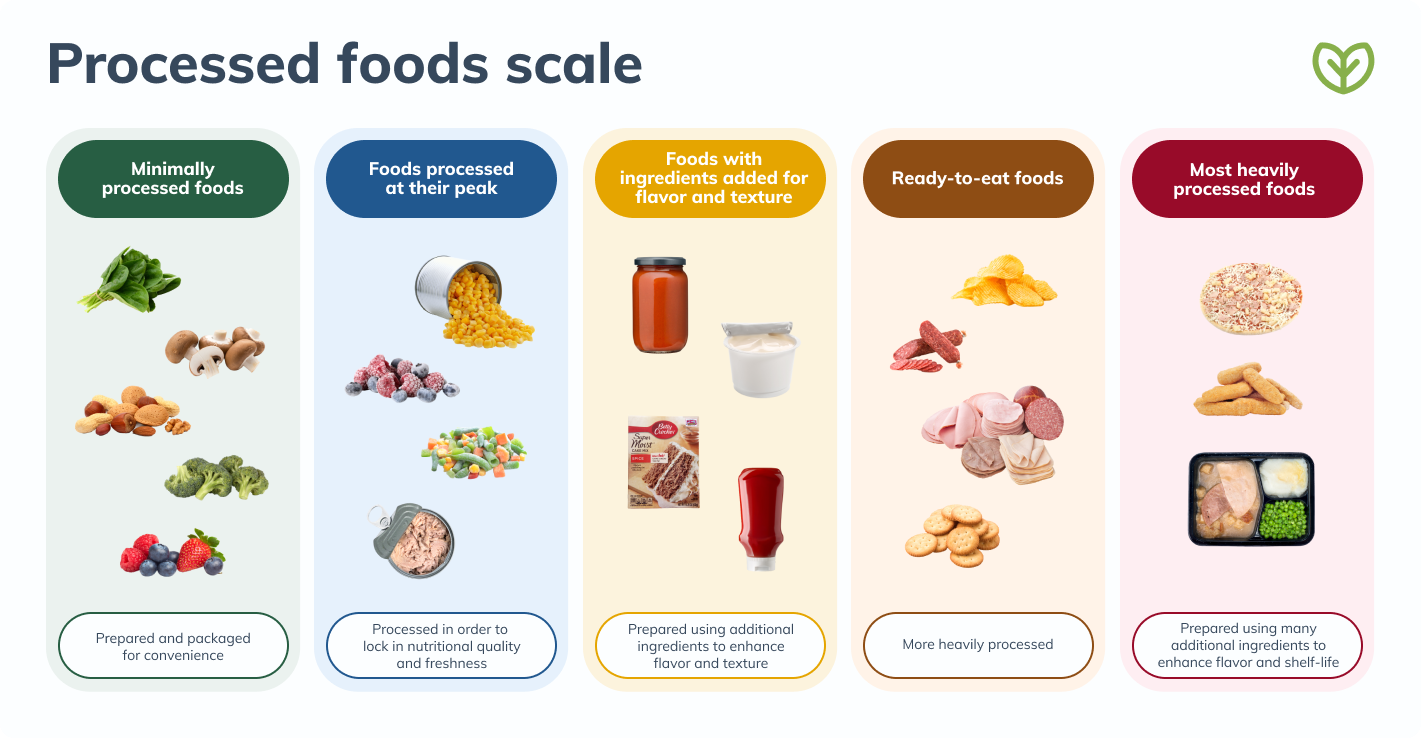
Processed foods scale showing 5 levels from minimally processed to most heavily processed foods

Visual reference used in clinical practice by Kerry Watson, NTP, RWP

The defining feature of Group 4 isn’t about empty calories. It is that the product contains industrial additives you would never keep in your home kitchen. Things like soy lecithin, citric acid, xanthan gum, “natural flavors,” carrageenan, and sodium benzoate are the real hallmarks of ultra-processing.

This is where the MRT connection becomes so important: we specifically test for many of these industrial additives on the MRT 176 panel.

The UPFโ€“MRT Connection

The Mediator Release Test checks your immune response to 176 substances, including 149 foods and 27 chemical additives. You find those 27 chemicals almost exclusively in ultra-processed foods:

MRT-Tested Chemical UPF Function Found In
Citric Acid Preservative, pH adjuster, flavor enhancer 38% of all products. Found in beverages, canned goods, snacks, and condiments.
Soy Lecithin Emulsifier 14% of all products. Found in chocolate, baked goods, supplements, and cooking spray.
MSG Flavor enhancer Chips, soups, frozen meals, and dressings. Often hidden as “yeast extract” or “natural flavors.”
Sodium Benzoate Preservative Soft drinks, salad dressings, condiments, fruit juices
Potassium Sorbate Preservative Cheese, yogurt, wine, dried fruit, baked goods
FD&C Yellow #5, Red #40, Blue #1 Artificial colorants Candy, cereals, beverages, medications, supplements
Polysorbate 80 Emulsifier, stabilizer Ice cream, pickles, vitamins, vaccines, cosmetics
Sodium Sulfite Preservative, antioxidant Dried fruit, wine, shrimp, maraschino cherries

Here is the critical insight. You cannot avoid these chemicals unless you stop eating ultra-processed foods. They don’t exist in nature. Where do you think these things come from? You will never find soy lecithin in a potato, citric acid powder in a chicken breast, or polysorbate 80 in an apple. You only eat them because industrial food manufacturers put them there.

What Our Database Reveals

We analyzed over 20,000 grocery products against the MRT 176 panel. The results show exactly how ultra-processing packs your food with MRT triggers:

85%

of products contain 5 or more MRT triggers

58%

contain cane sugar

38%

contain citric acid

4.1%

qualify as “Low Risk” (0-2 triggers)

That last number is the one you need to pay attention to. Only 4.1% of packaged grocery products have 2 or fewer MRT-tested triggers. The other 95.9% deliver multiple immune triggers with every single serving. The more processed the product, the more triggers you eat.

The 8 Worst UPF Additives for Food Sensitivity

These are the chemical additives found most often in ultra-processed foods that also appear on the MRT 176 panel. They are ranked by how often they show up in grocery products and how hard they are to avoid:

  1. Citric acid: In 38% of products. Manufactured from Aspergillus niger fermentation of corn sugar. Often triggers corn-sensitive individuals too.
  2. “Natural flavors”: A catch-all term that legally hides MSG, soy derivatives, corn derivatives, and dozens of other MRT-tested substances without naming them.
  3. Soy lecithin: In 14% of products. Used as an emulsifier in virtually all chocolate, most baked goods, and many supplements.
  4. MSG / free glutamate: Hidden under a dozen label names including “yeast extract,” “hydrolyzed protein,” and “autolyzed yeast.”
  5. Food dyes (FD&C Yellow #5, Red #40, Blue #1): Found in candy, cereals, beverages, and surprisingly, many medications and supplements.
  6. Sodium benzoate: Preservative in acidic foods. When combined with vitamin C (ascorbic acid), it forms benzene.
  7. Polysorbate 80: Emulsifier shown in research to disrupt the gut microbiome and increase intestinal permeability.
  8. Carrageenan: Thickener derived from seaweed. Found in plant milks, ice cream, and deli meats. It creates gut inflammation in animal studies.

Why UPFs Cause Symptoms You Can’t Explain

If you feel awful after eating packaged foods but can’t figure out which ingredient is causing the problem, this is why.

The “Additive Stacking” Problem

A single ultra-processed product like a flavored yogurt contains a lot of ingredients:

  • Cow’s milk (MRT-tested food)
  • Cane sugar (MRT-tested, found in 58% of products)
  • Citric acid (MRT-tested chemical additive)
  • Corn starch (MRT-tested via Corn)
  • “Natural flavors” (potentially containing MSG, soy, corn derivatives)
  • Soy lecithin (MRT-tested chemical)
  • FD&C Red #40 (MRT-tested dye)

That is over seven MRT-tested substances in a single serving of yogurt. If you react to even one of them, you get symptoms. Because the reaction is delayed by up to 72 hours, you cannot figure out which ingredient caused it. It is even harder when every meal you eat contains a similar cocktail of additives.

This is exactly why people with food sensitivities think their symptoms are random or unpredictable. The symptoms are not random at all. The same chemicals cause them, but those chemicals hide in different products across all your meals. You can’t see the pattern without testing because the chemical additives are your triggers, not the food itself.

What to Do About It

People tell you to just eat whole foods. That is good advice, but it doesn’t give you the whole picture. Here is what you actually need to do.

Without MRT Testing

  • Shift to NOVA Group 1 and Group 2 foods as much as possible
  • Read every ingredient list โ€” skip products with additives you don’t recognize
  • Avoid “natural flavors” and “yeast extract” โ€” the two biggest MSG vehicles
  • Cook from single ingredients at home
  • Keep a symptom journal to look for patterns

With MRT Testing

  • Get tested to identify which specific chemicals and foods trigger YOUR immune system
  • Work with a Certified LEAP Therapist to build a personalized protocol
  • Use the Food Checker to verify packaged products before buying
  • Know exactly which UPF additives you can tolerate and which you can’t
  • Make informed choices instead of eliminating all processed food permanently

The goal is not to swear off packaged food forever. The goal is to figure out which additives cause problems for your body so you can make informed choices instead of guessing. You might tolerate citric acid perfectly fine but get sick from soy lecithin. Someone else will have the exact opposite reaction. The MRT gives you the exact map of your own body.

PRACTITIONER INSIGHT

Ultra-processed foods are specifically designed to create a chemical reaction in the brain using flavor and texture profiles. This produces ongoing cravings for these tastes and textures. These products are so far removed from real food that the body often has no idea what to do with them. They create inflammation, get stored in our fat cells and overwork our livers that try to break down and detoxify the chemicals and preservatives from our bodies.

โ€” Kerry Watson, NTP, RWP • About Kerry

References: Bull, M. J., & Plummer, N. T. (2014). Part 1: The Human Gut Microbiome in Health and Disease. Integrative Medicine, 13(6), 17โ€“22. • Kinashi, Y., & Hase, K. (2021). Partners in Leaky Gut Syndrome: Intestinal Dysbiosis and Autoimmunity. Frontiers in Immunology, 12, 673708.

MSG and Food Sensitivity: What the MRT Panel Reveals

Kerry Watson, NTP, RWPKerry Watson, NTP, RWP
Nutritional Therapy Practitioner & Registered Wellness Professional • Evidence-based food sensitivity guidance

MSG is one of the most controversial substances in the food supply, and it is one of the 27 chemical additives specifically tested on the MRT 176 panel. You might think it is perfectly safe or a hidden poison, but the science behind mediator release testing tells a more nuanced story. Some people’s immune systems react to MSG, and for them, it is a clinically significant trigger.

What MSG Actually Is

Monosodium glutamate is the sodium salt of glutamic acid, an amino acid that occurs naturally in foods like tomatoes, parmesan cheese, and soy sauce. The manufactured form is the white crystalline powder added to processed foods. It was first isolated by Japanese chemist Kikunae Ikeda in 1908 and is responsible for the umami taste.

The FDA classifies MSG as “Generally Recognized as Safe”. This is technically accurate for the general population, but GRAS status doesn’t mean it is universally tolerated. It just means it is not acutely toxic at normal doses for most people. Aspirin is also GRAS, but millions of people can’t take it.

This distinction matters because MSG sensitivity is not an allergy. It is a non-IgE mediated immune response, which is the kind the MRT is specifically designed to detect. Traditional allergy tests like skin pricks and IgE blood panels will miss it completely.

MSG and the MRT Panel

The Mediator Release Test measures your white blood cells’ volumetric response to 176 substances, including MSG. When your blood is exposed to MSG in the lab, the test measures whether your immune cells release inflammatory mediators like prostaglandins, cytokines, histamine, and leukotrienes.

Your results will classify MSG as:

Green

Low reactivity. MSG is unlikely to trigger a significant mediator response in your body.

Yellow

Moderate reactivity. Avoid during Phase 1 and Phase 2. Reintroduce carefully in Phase 3 under CLT guidance.

Red

High reactivity. Avoid completely through all phases. MSG is a confirmed trigger for your immune system.

This is why the whole debate over whether MSG is safe misses the point entirely. It is safe for people whose immune systems don’t react to it. It is a clinically significant trigger for people whose MRT shows reactivity. The test resolves the debate on an individual basis.

Symptoms of MSG Sensitivity

Because MSG sensitivity is a mediator-driven response and not an IgE allergy, your symptoms can be delayed up to 72 hours and affect multiple body systems. Common reported symptoms include:

Neurological

  • Headaches and migraines
  • Brain fog and difficulty concentrating
  • Dizziness
  • Numbness or tingling (face, neck, arms)

Digestive

  • Bloating and abdominal cramping
  • Nausea
  • Diarrhea
  • IBS-like flares

Systemic

  • Fatigue and lethargy
  • Joint pain and muscle aches
  • Heart palpitations
  • Flushing and sweating

Skin

  • Hives and rashes
  • Eczema flares
  • Flushed or “hot” skin
  • Under-eye circles

The delay between consumption and symptoms is what makes MSG sensitivity so difficult to identify without testing. You might eat Chinese takeout on Tuesday and blame your Wednesday migraine on stress, the weather, or your sleep. You never connect it to the MSG in the soy sauce, broth, and seasoning.

The 12+ Hidden Names for MSG

This is where MSG avoidance gets difficult. The FDA only requires the label monosodium glutamate when pure MSG is added. But free glutamate is the same compound, and it can be introduced through processed ingredients that are not labeled as MSG. These ingredients contain significant amounts of free glutamic acid:

Always Contains Free Glutamate Often Contains Free Glutamate
  • Monosodium glutamate
  • Hydrolyzed vegetable protein
  • Hydrolyzed plant protein
  • Autolyzed yeast extract
  • Yeast extract
  • Sodium caseinate
  • Calcium caseinate
  • Textured protein
  • “Natural flavors”
  • “Seasonings” or “spices”
  • Bouillon, broth, stock
  • Maltodextrin
  • Whey protein concentrate
  • Soy protein isolate
  • Anything “protein-fortified”
  • Anything “enzyme-modified”

This is why products labeled as having no added MSG can still contain significant free glutamate. The label means they didn’t dump in a bag of pure MSG, but the hydrolyzed soy protein, yeast extract, and natural flavors in the ingredient list are delivering the same compound through the back door.

Where MSG Hides in Grocery Products

MSG and free glutamate are most concentrated in these product categories:

  • Chips and flavored snacks like Doritos, Cheetos, flavored nuts, and seasoned crackers
  • Canned and instant soups, which nearly all contain yeast extract or hydrolyzed protein
  • Frozen meals and TV dinners where natural flavors and soy protein isolate are standard
  • Salad dressings and marinades, especially ranch, Caesar, and Asian-style dressings
  • Seasoning packets like taco seasoning, ranch dip mix, and gravy packets
  • Deli meats and sausages where natural flavors and sodium caseinate are common
  • Fast food, where it is used extensively in sauces, breading, and seasoning blends
  • Health foods like protein bars, meal replacements, and flavored supplements

We analyzed over 20,000 grocery products and confirmed that avoiding MSG requires reading every single ingredient list or using a tool that does it for you.

What to Do If MSG Is on Your Red List

  1. Eliminate all sources of added free glutamate. Use the hidden names table above to identify MSG in ingredient lists, and when in doubt, just skip it.
  2. Cook from single ingredients during Phase 1. Meat, vegetables, fruit, and plain grains are naturally low in free glutamate. See our Phase 1 recipes for ideas.
  3. Use the Food Checker to search any packaged product against the MRT panel before buying.
  4. Watch for natural flavors and yeast extract because these are the two most common vehicles for hidden glutamate in products that claim to have no MSG.
  5. Be cautious with naturally high-glutamate foods. Parmesan cheese, aged cheeses, soy sauce, fish sauce, and miso contain naturally occurring glutamate. Your CLT will guide you on whether to include these.

PRACTITIONER INSIGHT

“The gut-brain axis connects the enteric nervous system to the central nervous system through the vagus nerve. When gut microbial balance is disrupted โ€” often by incompletely digested proteins and carbohydrates โ€” pathogenic bacteria produce lipopolysaccharide (LPS) endotoxins that cross the blood-brain barrier and trigger neuroinflammatory responses. This is one reason why MSG-reactive clients often report neurological symptoms like brain fog, migraines, and mood disturbances alongside digestive issues.”

โ€” Kerry Watson, NTP, RWP • About Kerry

References: Mayer, E. A., Tillisch, K., & Gupta, A. (2015). Gut/brain axis and the microbiota. Journal of Clinical Investigation, 125(3), 926โ€“938.

What Does “Natural Flavors” Actually Mean? A Food Sensitivity Guide

<a href=Kerry Watson, NTP, RWP” style=”width:56px;height:56px;border-radius:50%;object-fit:cover;border:2px solid #e2e8f0;float:left;margin-right:16px;margin-top:2px;” />Kerry Watson, NTP, RWP
Nutritional Therapy Practitioner & Registered Wellness Professional • Evidence-based food sensitivity guidance

You have probably seen it on almost every food label: “natural flavors.” It sounds harmless, maybe even healthy. If you live with food sensitivities, this two-word phrase is often the invisible reason you still feel terrible after eating foods you thought were safe.

This guide breaks down exactly what natural flavors are, what they hide, why they matter for food-sensitive individuals, and how tools like the MRT (Mediator Release Test) help you uncover triggers lurking inside that vague label line.

What does the FDA actually define as “natural flavors”?

Under 21 CFR 101.22, the FDA defines a natural flavor as:

“The essential oil, oleoresin, essence or extractive, protein hydrolysate, distillate, or any product of roasting, heating or enzymolysis, which contains the flavoring constituents derived from a spice, fruit or fruit juice, vegetable or vegetable juice, edible yeast, herb, bark, bud, root, leaf or similar plant material, meat, seafood, poultry, eggs, dairy products, or fermentation products thereof, whose significant function in food is flavoring rather than nutritional.”

In plain English: a “natural flavor” is any flavoring compound that originally comes from a natural source like plants, animals, yeast, or fermentation. But here is the catch: the final product can be heavily processed, chemically modified, and blended with dozens of other substances before it ends up in your food.

Key Distinction

The word “natural” in natural flavors refers to the starting material, not the finished ingredient. A flavor derived from a strawberry does not have to taste like strawberry, contain any actual strawberry, or be recognizable as anything from a strawberry plant.

Compared to artificial flavors, which are synthesized from non-food chemical sources, natural flavors simply start from something that was once part of a plant, animal, or fermentation process. The chemical structures of the final compounds can be identical. The distinction is about origin, not safety or simplicity.

What’s actually in natural flavors? The ingredient breakdown

A single “natural flavor” listed on a label can contain 50 to 100 individual chemical components. These fall into several categories:

Component Type What It Does Sensitivity Risk
Flavor Compounds Provide the target taste/aroma Moderate โ€” often derived from common allergens
Solvents Dissolve and carry flavor compounds (propylene glycol, ethanol) High โ€” propylene glycol is a known trigger
Emulsifiers Blend water-soluble and oil-soluble ingredients High โ€” often soy lecithin or polysorbates
Preservatives Extend shelf life of the flavoring Moderate-High โ€” BHA, BHT, sodium benzoate
Stabilizers Maintain consistency and prevent separation Moderate โ€” may include corn-derived ingredients
Color Modifiers Adjust visual appearance of the flavoring Moderate โ€” caramel color often corn-derived

Here is the part that frustrates food-sensitive individuals the most: manufacturers are NOT required to disclose the specific ingredients within their “natural flavors” blend. The entire mixture gets collapsed into two words on the label.

Did You Know?

According to the Environmental Working Group, “natural flavors” is the 4th most common ingredient listed on food labels in the United States, appearing on tens of thousands of products. Only salt, water, and sugar appear more frequently.

Hidden allergens and sensitivity triggers in natural flavors

This is where natural flavors become genuinely problematic for anyone managing food sensitivities or intolerances. Here are the most common hidden triggers that lurk inside a “natural flavors” listing:

๐ŸŒฝ Corn derivatives

Corn-based ingredients are among the most prevalent hidden components in natural flavors. Citric acid (often corn-derived), maltodextrin, dextrose, and corn-based ethanol are frequently used as carriers or solvents. If you react to corn, natural flavors are a likely culprit when you cannot pinpoint your trigger.

๐Ÿฅ› Dairy derivatives (casein and whey)

Casein and whey-derived compounds are used as flavor carriers in many savory and even some sweet natural flavor formulations. While the Top-8 allergen labeling law requires disclosure of milk as a major allergen, the threshold for disclosure and the interpretation of “incidental” varies. Food sensitivities (as opposed to IgE allergies) can be triggered at amounts well below allergen-labeling thresholds.

๐Ÿซ˜ Soy derivatives

Soy lecithin is one of the most common emulsifiers in the food industry. It shows up in natural flavor blends as a processing aid. Soy-derived tocopherols (vitamin E) are also used as preservatives in natural flavors. These may or may not trigger allergen disclosure depending on how they’re classified in the formulation.

๐ŸŒพ Wheat and gluten derivatives

While less common than corn or soy, wheat-based ethanol and hydrolyzed wheat protein appear in natural flavors. For individuals with celiac disease, this is a serious concern; for those with non-celiac wheat sensitivity, it is a source of persistent, unexplained reactions.

The 4 Most Common Hidden Triggers in Natural Flavors

๐ŸŒฝ
Corn
Citric acid, maltodextrin, ethanol carriers
๐Ÿฅ›
Dairy
Casein, whey, lactose-based carriers
๐Ÿซ˜
Soy
Lecithin, soy-derived tocopherols
๐ŸŒพ
Wheat
Hydrolyzed protein, wheat ethanol

Why natural flavors matter for food sensitivities

There is a critical distinction that most people miss: “natural” does NOT mean safe for food-sensitive individuals.

Food sensitivities involve delayed, dose-dependent inflammatory responses mediated by the innate immune system. Reactions can appear 4 to 72 hours after exposure, making it extremely difficult to trace the offending substance. When a hidden component inside “natural flavors” is your trigger, you may never connect the dots without specialized testing.

The elimination diet problem

Many clients come to us after months or even years on restrictive elimination diets with minimal improvement. Do you know what they were doing wrong? They removed whole foods from their diet but kept consuming processed products containing “natural flavors.” They never realized those two words were hiding the very chemicals causing their inflammation, bloating, headaches, or skin reactions.

This is why testing approaches like the food sensitivity test comparison are so important. Not all tests are created equal, and the ability to test chemical additives instead of just whole foods is a critical differentiator.

What People Assume The Reality
“Natural” means simple and pure Can contain 50 to 100 processed chemical components
It’s just one ingredient It’s a proprietary blend containing potentially dozens of substances
Allergens would be listed Only Top-8 allergens require disclosure; sensitivities are not allergies
If I don’t react immediately, it’s fine Sensitivity reactions can be delayed 4 to 72 hours
Elimination diets will catch it Hidden chemicals inside flavors are nearly impossible to isolate by elimination alone

The MRT connection: how the panel catches hidden triggers

The Mediator Release Test (MRT) is a patented blood test that measures your immune system’s inflammatory response to 176 foods and chemicals. What makes MRT uniquely valuable for the natural flavors problem is this: the MRT 176 panel tests 27 chemical additives that are commonly hidden inside natural flavors.

If you are not familiar with MRT, start with our detailed explainer: What Is MRT Testing?

Chemical additives the MRT 176 panel tests

These are some of the chemicals on the MRT panel that can hide inside “natural flavors”:

Flavor Carriers & Solvents

  • Propylene glycol
  • Ethanol (corn-derived)
  • Glycerin

Preservatives

  • Sodium benzoate
  • Potassium sorbate
  • BHA / BHT
  • Sodium sulfite

Emulsifiers & Stabilizers

  • Soy lecithin
  • Polysorbate 80
  • Carrageenan
  • Guar gum

Color & Flavor Enhancers

  • MSG (monosodium glutamate)
  • Caramel color
  • Vanillin
  • Citric acid

Why This Matters

If your MRT results show that you react to propylene glycol (a common flavor solvent), you now know that any product listing “natural flavors” is a problem. Propylene glycol is one of the most widely used carriers in flavoring formulations. Without MRT, you would never isolate that specific chemical as your trigger.

From MRT results to the LEAP ImmunoCalm Diet

Once your MRT results identify reactive chemicals, you work with a Certified LEAP Therapist to implement the LEAP ImmunoCalm Diet. This protocol systematically removes your personal triggers and reintroduces foods in phases. If you react to chemicals commonly found in natural flavors, you must learn to identify and avoid products with undisclosed flavor blends during the elimination phases.

Wondering about the investment? See our breakdown of MRT test cost and what it includes.

How to navigate food labels like a pro

Until labeling laws change, the burden falls on consumers to protect themselves. Here is a practical, step-by-step approach:

Step 1: Know your triggers first

You cannot navigate labels effectively if you don’t know what you are reacting to. This is where testing becomes essential. Our food sensitivity test comparison breaks down the differences between IgG panels, MRT, elimination diets, and other approaches.

Step 2: Learn the red-flag phrases

Watch for these terms on ingredient lists. They all potentially hide reactive components:

Natural flavors
Natural flavoring
Spices
Spice extractives
Other natural flavors
Flavor extract

Step 3: Contact manufacturers

You have the right to ask. Most manufacturers have customer service lines and some will disclose whether specific allergens are present in their flavor blends. Ask specifically about solvents and carriers because these are the components most likely to be omitted from voluntary disclosures.

Step 4: Choose products with full ingredient transparency

A growing number of brands now list every component of their flavoring on the label. These brands are your safest bet. Our Wellbloom product directory helps you find products that are compatible with your specific MRT results and sensitivity profile.

Which products to watch out for

Natural flavors show up in categories you’d expect and many you wouldn’t. Here are the product categories with the highest frequency of natural flavors on their ingredient lists:

Product Category Risk Level Common Hidden Components
Flavored sparkling water ๐Ÿ”ด High Propylene glycol, citric acid, ethanol carriers
Protein bars & shakes ๐Ÿ”ด High Soy lecithin, dairy derivatives, artificial sweetener blends
Yogurt & dairy alternatives ๐Ÿ”ด High Carrageenan, corn-derived stabilizers, guar gum
Salad dressings & sauces ๐ŸŸ  Moderate-High MSG, soy derivatives, wheat-based thickeners
Chips & snack foods ๐ŸŸ  Moderate-High Corn maltodextrin, yeast extract, caramel color
Cereal & granola ๐ŸŸก Moderate Vanillin, caramel flavoring, corn-derived carriers
Supplements & vitamins ๐ŸŸก Moderate Flavor masking agents, polysorbates, sugar alcohols

Surprising One

Flavored sparkling water is one of the biggest sleeper culprits. Brands market it as “zero calories, zero sugar, just water and natural flavors,” but those natural flavors can contain propylene glycol, corn-derived citric acid, and other chemical additives. Many of our clients are shocked to discover their “healthy” water habit was contributing to their symptoms.

How Wellbloom’s product directory helps

This is exactly the problem we built the Wellbloom product directory to solve.

Our directory catalogs products with full ingredient transparency and cross-references them against the MRT 176 panel’s chemical additives. For each product, you can see:

  • Complete ingredient lists โ€” including what is inside flavor blends when manufacturers disclose them
  • Chemical additive flags โ€” products containing known MRT-tested chemicals are clearly marked
  • Category filtering โ€” search by food category, dietary need, or specific ingredient to avoid
  • Sensitivity-friendly alternatives โ€” find swap options when your go-to product contains a trigger

Instead of spending hours in the grocery aisle squinting at labels and Googling ingredients, you can plan your shopping in minutes. It is especially helpful when paired with your MRT results and your LEAP therapist’s guidance.

Frequently Asked Questions

Are natural flavors the same as artificial flavors?

No, but the difference is smaller than you think. Natural flavors must originate from a natural source (plant, animal, or fermentation), while artificial flavors are synthesized from non-food chemicals. However, the final chemical compounds can be structurally identical. From a food sensitivity standpoint, both can contain the same reactive solvents, carriers, and preservatives. The “natural” label does not make a flavor blend safer for sensitive individuals.

Can I be allergic to natural flavors?

Yes, it is possible. Natural flavors can contain derivatives of common allergens including soy, dairy (casein and whey), wheat, and corn. While FALCPA requires disclosure of Top-8 allergens, the interpretation of “incidental” and threshold amounts varies. Food sensitivities (non-IgE-mediated reactions) can be triggered at levels well below allergen-disclosure thresholds, making natural flavors a common source of unexplained reactions.

How can I find out what’s in the natural flavors in a specific product?

You have three options: (1) Contact the manufacturer directly and ask about specific components, solvents, and carriers used in their natural flavor formulation. (2) Use a product database like the Wellbloom product directory that catalogs ingredient transparency. (3) Choose brands that voluntarily disclose full flavoring components on their labels. A growing number of clean-label brands now provide this transparency.

Does the MRT test specifically test for natural flavors?

The MRT doesn’t test “natural flavors” as a single item. Instead, it tests the individual chemical additives commonly found within natural flavor blends, including propylene glycol, soy lecithin, MSG, sodium benzoate, potassium sorbate, and 22 other chemicals. This is actually more useful than testing the blend itself, because it tells you exactly which component is triggering your immune response. Learn more about how MRT testing works.

Are organic products free of natural flavors?

Not necessarily. USDA Organic products can contain natural flavors because the organic certification places restrictions on certain synthetic processing aids, but natural flavor blends are still permitted. Organic natural flavors may use fewer synthetic solvents, but they can still contain allergen-derived carriers and reactive compounds. “Organic” and “free of hidden triggers” are not the same thing. Always read the full ingredient list, even on organic products.


Medical Disclaimer

This article is for informational and educational purposes only and does not constitute medical advice. The content is not intended to diagnose, treat, cure, or prevent any disease or condition. Food sensitivities and allergies are complex and individual, so always work with a qualified healthcare provider or Certified LEAP Therapist before making changes to your diet. The MRT test and LEAP protocol should be administered under the guidance of a trained practitioner. Wellbloom Nutrition does not provide medical diagnoses.

Medical Disclaimer: This data is algorithmically generated based on USDA databases and is not medical advice. Always consult your Certified LEAP Therapist.